
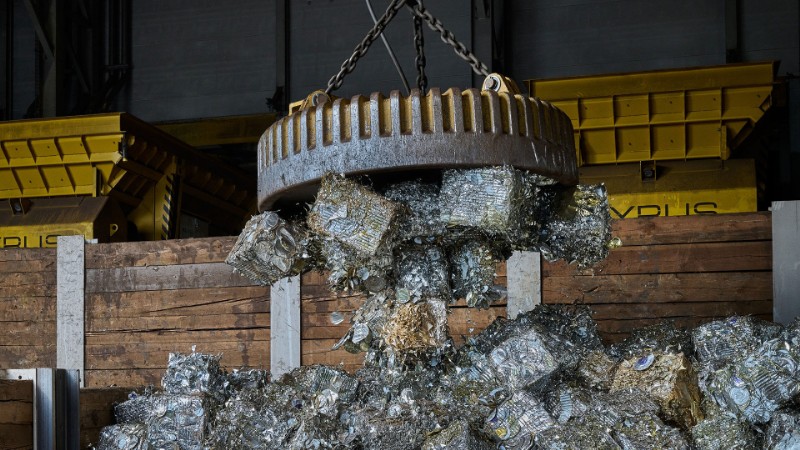
What if the key to lower emissions and costs at the foundry wasn’t shiny new tech – but in yesterday’s leftovers?
That’s the idea behind a circularity pilot at Scania’s foundry.
Deep within the melting operations, a quiet transformation is underway – one that proves sustainability and cost efficiency can go hand in hand. The mission was clear: reduce the use of virgin materials without compromising quality or production output. This pilot project is rethinking how we manufacture engine blocks and cylinder heads by turning scrap metal into valuable resources.
Breaking free from virgin material dependency
Traditionally, the foundry relied on pig iron, a virgin material mined in Brazil and shipped across oceans. Not only was it expensive, but its carbon footprint, from extraction to transport, didn’t align with Scania’s climate goals.
“Three years ago, we were using about 30% pig iron,” says Christopher Armstrong, Process Engineer at Scania’s foundry. “We got it down to 10% last year. And this year, we’re pushing for just 5%.”
Christopher Armstrong, Process Engineer at Scania's foundry, standing infront of compressed scrap metal ready for melting.
Engineering chemistry drives circularity forward
Christopher’s assignment? Source metal scrap with the right chemistry and physical properties to match the rigorous standards for engine parts. That’s easier said than done.
“Buying scrap isn’t hard,” explains Thomas Lindstedt, Production Manager. “But buying scrap with the exact chemistry we need can be tricky. Some trace elements can destroy the properties of the iron.”
Thomas Lindstedt, Production Manager at Scania, standing infront of compressed scrap metal ready for melting.
Thomas Lindstedt, Production Manager
Thomas highlights the complexity: “What Christopher has done is deep engineering. He found the sweet spot, combining materials in a way that reduces emissions and cost, without compromising quality.”
Here, we test each casting’s quality by extracting a small sample – shown as the round silver disc beneath the copper piece held by the operator.
A Scania employee holding copper scrap sourced from Scania's Oskarshamn site.
Christopher clarifies, “Each potential scrap source undergoes rigorous testing to see if there are any casting defects. It involves small test batches, larger trials, and full-scale production runs over time.”
“We also started reusing copper scrap from our Oskarshamn site, parts they can’t use anymore in their welding process. Instead of selling that scrap, we melt it down and turn it into new engine parts,” Christopher says. The result? Reduce waste, cut transport costs, and lower emissions all within Scania.
What’s the payoff?
CO₂ emissions: Reduced by replacing virgin pig iron with locally sourced scrap.
Cost savings: Avoiding pig iron cuts purchasing costs and removes the dealer's markup on scrap resale.
Circularity gains: More materials now stay within Scania’s ecosystem, contributing directly to Scania’s sustainability goals.
The results speak for themselves: In 2024 alone, the foundry cut the cost per melt by 7%.
To put that in perspective, a single melt is like baking a large batch of metal "dough" – it’s one full furnace load that produces enough material for 72 cylinder heads. With thousands of melts processed over the year, those savings add up.
This shift also contributed to a reduction of about 8,000 tonnes CO₂e – that’s roughly taking 1,700 cars off the road for a year.
With these initial achievements, the foundry is moving forward, encouraged to pursue even greater emissions reductions and cost savings in 2025.
Raw scrap metal in an open truck trailer arriving at Scania’s foundry, ready to be melted down and recycled as part of Scania’s sustainable manufacturing process.
Raw scrap materials as delivered to our foundry, ready to be melted down.
The foundry isn’t stopping here. It’s also part of the project CASTWELL, a Swedish initiative led by RISE (Research Institutes of Sweden) and other industry leaders, aimed at identifying CO₂ hotspots and developing climate-neutral foundry practices by 2040.
Christophere adds: “The most important part of this circularity project is that we're all working towards the same goal – producing the best engines on the market in the most sustainable way possible, minimising our environmental impact.”
-------------------------------------------------------------------------------------------------------
For OEM Scania Truck Parts visit http://www.swedishtruckpartsshop.co.uk/scania-parts-8-c.asp
For more information on genuine OEM ScaniaTruck Parts for the UK and worldwide
Please E-mail Tony / Graham
stpuk@swedishtruckparts.co.uk